
BigCommerce: Scale Your Ecommerce Empire with Flexibility and Power
Store BuildersDescription
Think big — and grow bigger — with our flexible, professional-grade ecommerce platform.
Why It Stands Out
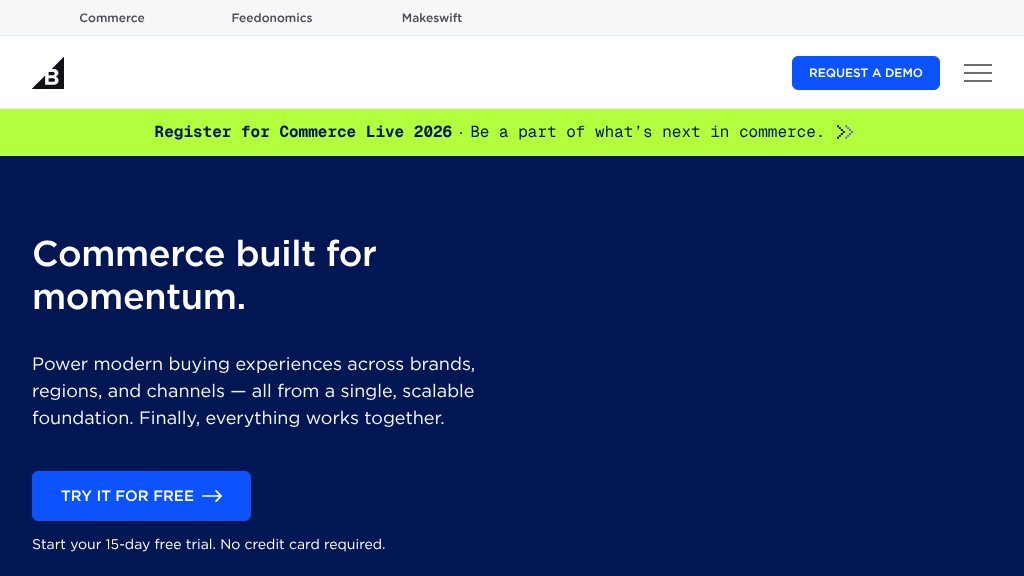
Businesses comparing ecommerce platforms are usually deciding whether they need a straightforward store builder or a system that can support more complex operations over time. BigCommerce is positioned for the latter: it combines visual storefront tools with open APIs, multi-storefront management, B2B commerce features, product feed management, and connections to external business systems.
The platform is designed to accommodate different selling models rather than requiring every merchant to follow the same setup. A brand can launch with a customizable storefront, then add more advanced development, channels, or operational workflows as its requirements change.
How It Can Be Used
BigCommerce supports both direct-to-consumer and business-to-business selling. B2B capabilities shown on the site include account-specific pricing, product access, payment terms, buyer roles, approvals, quotes, reorders, invoice payments, and self-service account management. Businesses selling to consumers can also use one-page checkout, digital wallets, buy-now-pay-later options, product variants, bundles, and configurable products.
Beyond the main storefront, merchants can reach customers through Google, Meta, TikTok, Amazon, Walmart, and eBay. Multi-language and multi-currency support is available for businesses serving more than one market. The platform also highlights subscriptions, hybrid B2B/DTC models, restricted-category selling, and multiple storefronts managed from one system.
Strengths
- Supports B2C, B2B, multi-storefront, and international commerce use cases
- Combines visual store building with open APIs and developer tools
- Connects selling across social platforms, search, and major marketplaces
- Offers product, checkout, payment, and catalog features for complex selling models
Cons
- The breadth of features may be more than a small or simple store requires
- Advanced customization, migration, and B2B implementations may need specialist support
- Pricing, plan limits, regional availability, and exact integration coverage require direct confirmation
Important Details
Store creation can be handled visually or through code, while open APIs support more customized commerce experiences. The website lists more than 1,200 apps and separately references 600+ integrations for systems such as ERP, CRM, PIM, and WMS tools. Payment options include 20+ embedded payment providers and access to 130+ payment solutions; visitors should confirm current availability and applicable terms for their region.
A free trial is advertised without requiring a credit card, and the trial store can be populated with products and configured before launch. BigCommerce states that most stores go live within 30 days, while B2B portals typically take 60–90 days. Those timelines are indicative rather than a substitute for a project assessment.
Possible Fit and Evaluation Notes
BigCommerce may suit growing brands, merchants with complex catalogs, B2B sellers, and teams that need multiple channels or a more extensible technical foundation. It may be more capability than a very small business needs, particularly if the priority is the simplest possible setup. More advanced implementations may also require development, migration, or professional services.
Before choosing it, confirm pricing, plan limits, regional payment support, the exact integrations required, and which features need additional configuration. Overall, BigCommerce is worth evaluating when flexibility and operational depth matter as much as getting a storefront online.
Embeds
Copy short script widgets for this listing. People often use Textfrog to search for their next personal or work tool. Encourage your community to leave reviews on Textfrog.
Review widget
A clean review badge with stars and review count.
Featured badge
A compact badge for products listed on Textfrog.
Similar Tools
WooCommerce is the open-source ecommerce platform that helps merchants and devel...

Try Shopify free and start a business or grow an existing one. Get more than ec...
Featured Links
Eduify is an online education platform that provides tools and resources for lea...