
Rocket: Streamlined AI App Builder & Competitive Market Intelligence Platform
Chatbots & AssistantsDescription
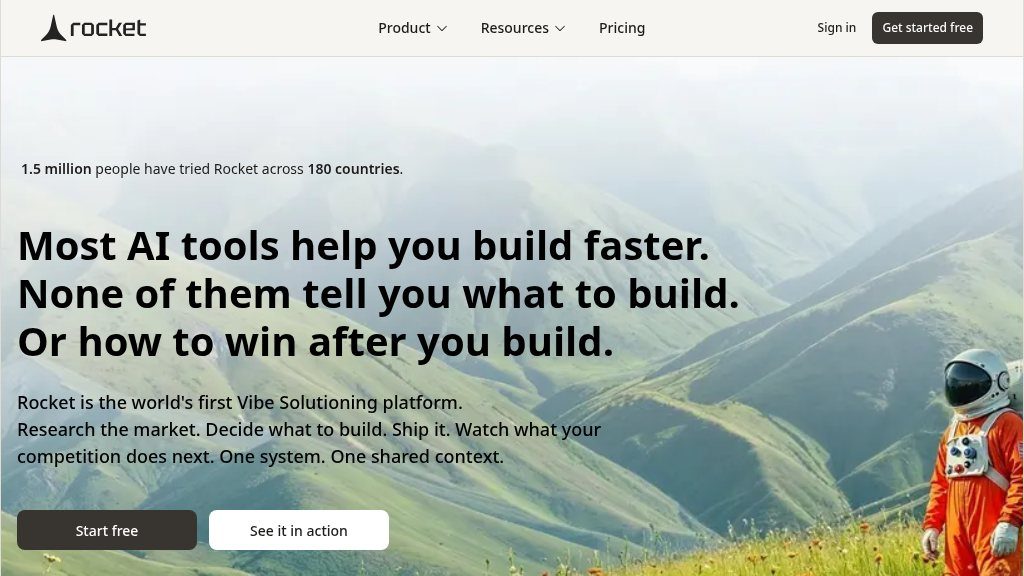
You describe the problem. Rocket researches the market, recommends what to build, generates production-ready code, and tracks your competitors. One system.
Why It Stands Out
Rocket is aimed at people who need to decide what to build, turn that decision into a working product, and keep track of market changes afterward. That makes it relevant to solo founders, product teams, engineering teams, sales leaders, and consultants—not just developers looking for an AI code generator.
Its main distinction is the connection between three stages that are often handled separately: market research, software creation, and competitor monitoring. The platform describes this as a shared-context workflow, so research and product decisions can carry into the building stage without being re-entered from scratch.
How It Can Be Used
The Solve workflow accepts a market problem, decision, or opportunity, with the option to add supporting documents, presentations, or links. Rocket says it can return research, evidence, and recommendations covering areas such as market analysis, product direction, growth strategy, go-to-market planning, and regulatory research.
Those recommendations can then move into Build, where users create web apps, mobile apps, landing pages, SaaS products, internal tools, and dashboards through natural-language prompts or existing context. The page also mentions staging and production environments, one-click deployment, Figma import, templates, and connections to internal systems, APIs, and third-party tools.
The Intelligence component focuses on ongoing competitor observation. Listed signals include pricing changes, messaging updates, launches, hiring activity, website changes, social media, and broader product or sales indicators. Daily briefs and continuous monitoring are presented as ways to turn those changes into usable product or sales intelligence.
Strengths
- Connects market research, product recommendations, app generation, and competitor monitoring in one workflow
- Supports several output types, including web and mobile apps, landing pages, SaaS products, dashboards, and internal tools
- Carries context from research into the build process to reduce repeated setup
- Lists enterprise-focused controls and standards such as SSO/SAML, audit logs, SOC 2, and ISO 27001
Cons
- The available page information does not clarify pricing, code ownership, export options, or supported technology stacks
- Competitor monitoring coverage and the accuracy of its recommendations should be validated for the specific market
- The platform may offer more scope than users who only need a focused no-code app builder require
Important Details
The site lists enterprise-oriented controls and standards including SOC 2, ISO 27001, GDPR, CCPA, SSO/SAML, role-based access, and audit logs. These are important considerations for teams handling internal or customer-related information, but visitors should confirm the scope, availability, and current status of each item directly with Rocket.
The homepage also states that 1.5 million people have tried the platform across 180 countries. That is a site-provided usage claim rather than an independent evaluation, and it does not indicate how many users are currently active or which features they use.
Possible Fit and Evaluation Notes
Rocket may suit teams that want a connected path from opportunity research to prototype or deployment, particularly when competitor activity is part of ongoing product planning. It may be less suitable for buyers who only need a narrowly focused app builder or who require detailed information about supported technology stacks, deployment controls, pricing, code ownership, and integration limits before testing.
Overall, Rocket is best evaluated as a combined research, AI app-building, and competitive-monitoring workspace. Before adopting it, confirm pricing, generated-code workflows, export and hosting options, connector coverage, data handling, and the exact depth of competitor intelligence available for your market.
Embeds
Copy short script widgets for this listing. People often use Textfrog to search for their next personal or work tool. Encourage your community to leave reviews on Textfrog.
Review widget
A clean review badge with stars and review count.
Featured badge
A compact badge for products listed on Textfrog.
Similar Tools
The top uncensored AI models - chat, generate, media, voice, API & more. with pr...
Rork builds complete, production-ready mobile apps from your description using A...
A cloud computer where AI agents run your company. Connect 3,000+ tools, configu...
Runable is the world's best AI general agent that can think, plan, and execute e...
Featured Links
Eduify is an online education platform that provides tools and resources for lea...