
DesignMD: Instantly Create Detailed DESIGN.md Files from Any URL
Ai Writing & ContentDescription
Paste a URL. Get a complete DESIGN.md file in seconds. Extract design tokens, typography & component styles — ready for AI coding agents.
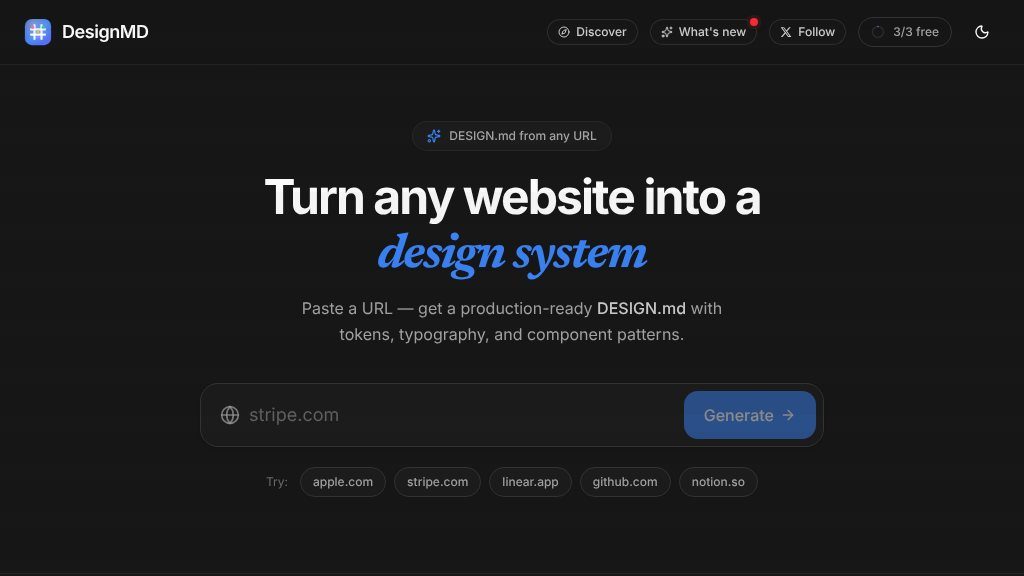
Website Overview
Design handoffs often lose important details between a visual reference and the code that recreates it. Colors, spacing, typography, and component styling may be visible on a webpage, but turning those observations into organized documentation can take considerably more time. DesignMD appears to address this gap by generating a structured DESIGN.md file from a supplied URL.
The service is positioned as a focused bridge between web design references and implementation notes. Rather than asking users to document every style decision manually, it aims to collect key visual information in a format that can be used during design-to-code work.
Experience and Functionality
The stated workflow is straightforward: paste a webpage or design URL, then receive a generated DESIGN.md file. According to the available description, the output covers several areas that developers and designers commonly need when recreating an interface:
- Design tokens, including reusable visual values such as colors and spacing
- Typography details, such as fonts, sizes, weights, and line heights
- Component styles that describe how interface elements are presented
- Documentation formatted for use with AI coding agents
This makes the tool particularly relevant when a team wants a concise reference document rather than a collection of loosely organized observations. However, visitors should verify how accurately the service handles different page structures, dynamic content, custom fonts, and styles that are difficult to infer from a live URL. The available information does not establish the depth or consistency of its extraction across websites.
Strengths
- Generates a structured DESIGN.md file from a supplied URL
- Focuses on useful design details such as tokens, typography, and component styles
- Positions the output for AI-assisted design-to-code workflows
Cons
- Extraction accuracy may vary across different page structures and dynamic interfaces
- Generated documentation should be reviewed rather than treated as a complete replacement for design specifications
Useful Scenarios
DesignMD may be useful when a developer needs an initial styling reference for an existing webpage or when a team wants to create documentation before asking an AI coding agent to assist with implementation. It could also support early design-to-code exploration, where identifying recurring tokens and component patterns helps establish a more consistent starting point.
For design teams, the generated file may provide a practical handoff artifact. For developers, it may reduce the amount of manual inspection required before translating a visual interface into code. The result should still be reviewed against the source page, especially for production work where visual accuracy matters.
Who May Benefit
Front-end developers, UI/UX designers, product teams, and developers using AI coding agents are the clearest potential audiences. It is most relevant to people who regularly move between webpage references, design documentation, and implementation tasks.
Final Perspective
DesignMD presents a narrowly defined approach to a familiar workflow problem: turning a URL into structured design documentation. Its value will depend on the accuracy and completeness of the generated DESIGN.md files, so prospective users should test it with representative pages and confirm what information is captured. For teams seeking a faster starting point for design handoffs or AI-assisted coding, the service appears worth investigating.
Embeds
Copy short script widgets for this listing. People often use Textfrog to search for their next personal or work tool. Encourage your community to leave reviews on Textfrog.
Review widget
A clean review badge with stars and review count.
Featured badge
A compact badge for products listed on Textfrog.
Similar Tools
Meet Z.ai, your free AI-powered assistant. Build websites, create slides, analyz...
Your AI-powered hub for seamless social media scheduling and content creation. E...
Dynamic practice questions, citation-based chatbots, interactive study guides, a...
Explore our collection of recommended links or submit your own to share with the...